Multi-Channel Extraction
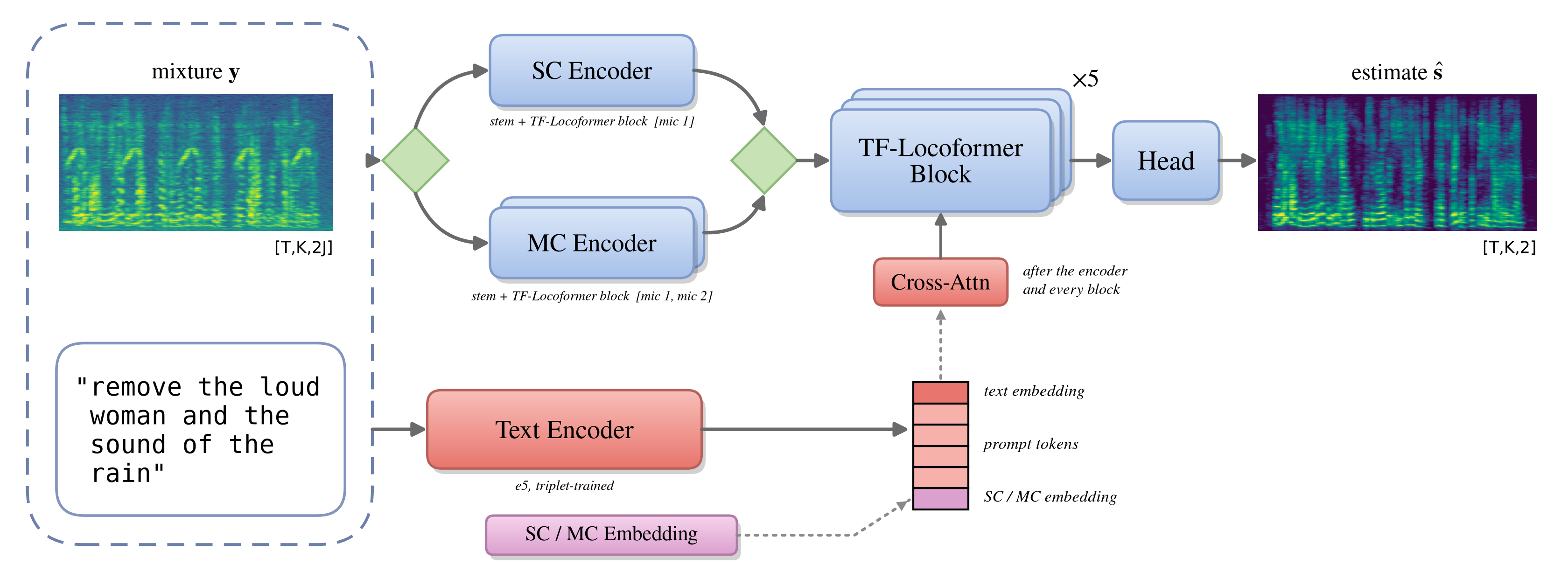
Two speakers and two noise sources are captured by a two-microphone array in a reverberant room. A free-form prompt names which entities to keep or remove, and the model reconstructs exactly that subset — exploiting spatial diversity when it is available.
Remove the weak speaker.
Kindly eliminate the loudspeaker from the recording.
Eliminate the gentle mallet instrument playing a delicate melody and the guy speaker.
Exclude the running motor vehicle engine, the softly purring cat, and the loud guy speaker, while keeping the female weak speaker.
Preserve the chime ringing, exclude the speakers, and keep the door opening and closing sounds.
Single-Channel Extraction
The same text-guided extraction from a single microphone, with no spatial cues at all. Separation is driven purely by the semantic attributes in the prompt (gender, relative loudness, noise identity).
Maintain the female, continue with the motorboat engine sound, and exclude the cat's meowing.
Kindly eliminate the guy.
Maintain the presence of the person playing a musical instrument, keep the water splashing and gurgling sounds, and eliminate both the man weak speaker and the female loud speaker.
Eliminate the sound of the race car accelerating and revving, as well as the female.
Kindly eliminate the guy speaker and the steady rhythm of the acoustic guitar.
Maintain the Drum and Bass music in the background and continue featuring the guy.
Spatially-Guided Extraction
Here the prompt describes a speaker by relative position rather than voice attributes — e.g. “the voice closer to the array” or “the speaker on the left.” The model resolves the relative spatial relation between the two talkers.
Isolate the speaker found to the left side
Separate the speaker situated toward the left
Extract the speaker situated toward the left
Keep the voice who is farther away and oriented more to the right
Isolate the voice that is nearer and facing more leftward
Multi-Channel Enhancement
A single target speaker buried in heavy background noise, recorded on two microphones. The prompt simply asks to keep the speaker / remove the noise; enhancement is handled as a special case of the same extraction model. These examples were chosen for their very low input SNR to show the denoising under hard conditions.
Remove all background noise and preserve only the primary speaker.
Extract the human voice and discard any background noise.
Clean this clip by removing all noise and retaining only the human voice.
Isolate the vocal track and eliminate unwanted noise such as traffic, people talking, or machinery.
Suppress noise and enhance the clarity of the vocal track.
Single-Channel Enhancement
The same denoising from a single microphone. On this task Textraction surpasses the dedicated HD-DEMUCS-TF baseline, despite being a general text-guided extractor. Again, the noisiest inputs were picked on purpose.
Remove background chatter and retain only the speaker.
Remove background chatter and retain only the main voice.
Denoise this recording so that only the speaker remains clearly audible.
Suppress noise and enhance the clarity of the primary speaker.
Keep only the human voice and eliminate everything else.